Six months of the EPS Simulator. How is it being used to enhance prescribing education?

Can you believe it’s been six months since we launched the EPS Simulator? Since then we’ve seen institutions who have started integrating it into their teaching programmes and we’re already hearing some really encouraging feedback from educators and students.


How does it work?

One of the biggest challenges in prescribing education is giving students meaningful exposure to decision making before they step into a clinical environment. Reading about prescribing and actually doing it are very different experiences, and the gap between the two has been a challenge for educators.


The EPS Simulator was built to replicate the kind of electronic prescribing system students will encounter in hospitals and clinics, it gives them a space to think through complex decisions, make mistakes safely and develop the judgement that comes with practice. With over 4,000 medications available and the ability to build scenarios around detailed patient histories, clinical presentations and allergies, educators have enormous flexibility in how they use it.


What institutions are doing with it

It has been really insightful to see how institutions are shaping the Simulator around their own curricula. When students engage with a realistic prescribing interface regularly, it changes how they approach the subject altogether.


During Pharmacology 2025 in December last year, Professor Kurt Wilson and Hiten Mitha from the University of Manchester presented on how they have been integrating the EPS Simulator into their programme.


The University needed “something that mirrors those clinical processes but doesn’t have all the hindrances that the real clinical systems have.” With 2,500 students spread across different NHS trusts, they also needed one platform that worked for everyone.


They ran a pilot with final year students through two immersive sessions. One was a secondary care session that placed students in the role of a foundation doctor looking after a ward of five patients, working through prioritisation, prescribing decisions and team communication. Facilitators act as nurses, radiologists and other clinical staff, so students can realistically engage as they would in practice. There was also a primary care session that consisted of a  two hour GP session, covering acute appointments, duty doctor tasks, prescription reviews and complex polypharmacy cases.


Despite no prior introduction to the Simulator, students got to grips with it quickly. The team noted that the transition was straightforward and the immersive format clearly landed well. In the words of the team: “it’s not just about writing a prescription, it’s about how you administer it, how you communicate this to the other healthcare professionals and the patient.” That broader picture is exactly what the sessions are designed to bring out.


The response from the Manchester University team was really encouraging to hear. They described the sessions as genuinely immersive, with students engaging in a way that felt true to clinical practice rather than just an assessment exercise. The combination of prescribing decisions, prioritisation and real-time communication gave students a much richer experience than working through questions in isolation. 


Feedback from educators and students continues to shape how we develop the tool, and there is plenty more to come. If you’d like to see the EPS Simulator in action and explore how it might fit into your prescribing curriculum, we’d love to show you around.


Request a demonstration at www.bpsassessment.com/eps-simulator

Prescribing Safety Progress in 2025

In 2025, BPS Assessment continued to develop and deliver digital learning and assessment tools that support safer prescribing across education and training settings. Over the past year, our focus has been on expanding the reach of the BPS Assessment Hub, improving our platform and products, and responding to the needs of the wider prescribing community.


The Hub provides a comprehensive platform for prescribing learning, practice and assessment. Developed with support from UK experts and aligned with current clinical guidance, it supports educators in delivering structured prescribing education, whilst helping learners build the skills required for safe practice. As prescribing safety remains a concern, reliable and well-designed digital tools play an important role in supporting and standardising teaching and assessment.


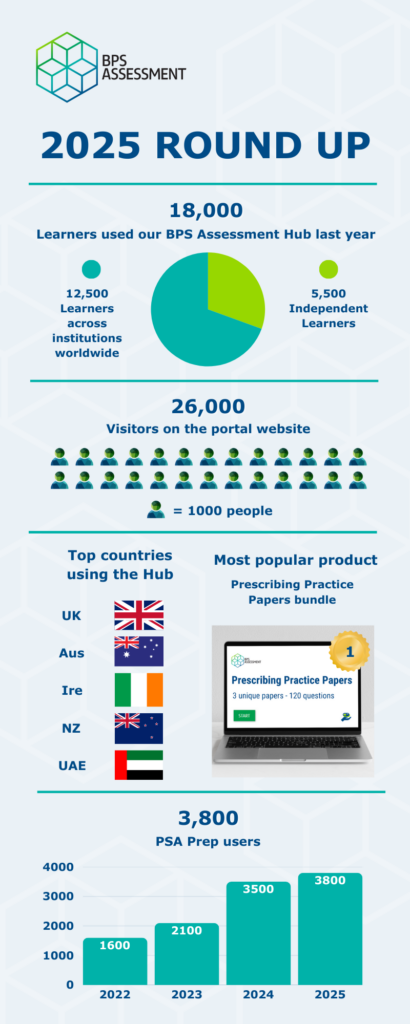
Engagement with the platform continued to grow throughout 2025. More than 26,000 users accessed the Hub, with 18,000 learners actively using our assessment and practice resources. These figures reflect ongoing confidence from universities, training providers, and healthcare organisations using the Hub to support their prescribing programmes.


International uptake of the Hub also continued to grow – in addition to strong use across the UK, organisations and independent learners accessed the platform from Australia, Ireland, New Zealand, the United Arab Emirates and other regions, demonstrating its relevance across broad education and training environments.


In the past year, we also saw a strong uptake of our assessment resources. The Prescribing Papers Bundle was the most purchased product, combining our three Practice Papers in a discounted bundle. With 120 questions, a 60-item mock exam and detailed feedback, the bundle supports programme delivery and learner preparation for the Prescribing Skills Assessment. In addition, 3,800 learners used PSA Prep, our free resources designed to complement teaching programmes and support medical students with top concerns. 


We also continued to invest in innovation, including the development of new tools such as the EPS Simulator, which enables learners to practise prescribing in a simulated electronic prescribing environment.


These developments highlight our commitment to supporting organisations and learners with prescribing education as we look forward to a new year of innovation. If your organisation is interested in learning more about how the Hub might support your programmes, please get in touch to book a demo and explore the platform in more detail.

We’re looking for 3 new Authors at BPS Assessment

Foundation level prescribers rely on high quality educational resources to develop the clinical judgement and skills they need in practice. The questions they work through during training help build confidence and competence in prescribing safely.


We’re looking for three registered doctors or pharmacists who are currently in clinical practice to join our authoring team at BPS Assessment. If you have experience working with foundation level prescribers in the NHS, this is an opportunity to draw on that experience and contribute to educational content that supports their development.


As an author, you’ll be crafting and reviewing prescribing education questions across our eight Prescribing Skill Assessment item styles. You’ll be working within our house style guide and PSA blueprint, ensuring everything aligns with standard UK practice and current BNF and NICE guidance. Your role is to create scenarios that reflect the complexity and nuance of clinical practice, with challenges that really test understanding and build competence.


We’re asking for around 10 hours per month, which allows you the flexibility to fit this work around your clinical commitments. The remuneration ranges from £35 to £105 per question, depending on the complexity and question type. One thing to note is that being a BPS Assessment author precludes being able to write, edit, review or approve content for the national high-stakes Prescribing Safety Assessment at the same time.


The resources you help create will reach thousands of prescribers at a formative stage in their careers. You’ll be contributing to a safer, more competent healthcare workforce and doing it from a position where your clinical expertise directly informs educational excellence.


If you’re interested in finding out more, get in touch with Marcus Hughes or Peter Wright at bpsassessment@bps.ac.uk  for a full job description. 


We’re excited to hear from clinicians who want to extend their impact beyond their immediate practice and help shape how the next generation learns to prescribe safely.