The BPS has updated its undergraduate curriculum. Here’s a quick overview

The British Pharmacological Society recently published an updated curriculum for the teaching of clinical pharmacology, therapeutics and prescribing in medical degrees and if you work in medical education it is well worth a read.


Prescribing a medicine is the most common patient facing healthcare intervention, and the process is a complex one. The curriculum sets out the core knowledge and skills that graduating doctors will need as a foundation for safe and effective prescribing throughout their careers. 


The curriculum is divided into four sections and the first covers the principles of clinical pharmacology, giving students the foundations they need early in their degree. The second is a suggested student formulary, a core list of drugs that a graduating doctor should know in some depth. The third addresses therapeutics, covering the clinical conditions and their pharmacological treatment that every graduating student needs to understand. The fourth focuses on prescribing and related skills. 


Importantly, the curriculum is designed to be flexible in how its content should be delivered. Individual medical schools are best placed to decide how to use it within their own programmes and it is designed to serve as a supportive framework for mapping learning rather than a rigid instruction. 


The updated curriculum was produced through a modified Delphi process involving experts with a broad experience of clinical pharmacology education from across the United Kingdom, and was overseen by a steering committee of expert educators in the field.


At BPS Assessment, a number of our eLearning modules and assessments already align closely with areas covered across the four sections in the curriculum. If you are reviewing how your teaching maps to the updated guidance, our resources may be a useful complement.


Get in touch with the BPS Assessment team if you would like to find out more.


You can view and download the full BPS curriculum here 

Supporting Prescribing Education in the Middle East: RCSI Bahrain and the University of Sharjah

Prescribing errors are one of the most significant and preventable causes of patient harm in healthcare systems around the world. Tackling that problem starts in medical education, which is why we are seeing more and more institutions turn to structured, evidence based tools to sharpen how their students learn to prescribe.


RCSI Bahrain and the University of Sharjah are two institutions doing exactly that, and both have chosen BPS Assessment’s platform to help give their students a stronger foundation in prescribing education. This builds on an already established and growing presence in the region. We have been working with institutions across the Middle East for a number of years, including Gulf Medical University, and it is encouraging to see that momentum continue.


Royal College of Surgeons in Ireland (RCSI Bahrain)

The Royal College of Surgeons in Ireland (RCSI Bahrain) is a medical university in the Gulf region. A constituent university of RCSI Dublin, which was founded in 1784, the Bahrain campus has been training healthcare professionals since it opened in 2004. There are students across its Schools of Medicine, Nursing and Midwifery and Postgraduate Studies and Research, and its graduates hold internationally recognised qualifications from both RCSI and the National University of Ireland.


RCSI Bahrain has embedded BPS Assessment’s platform into their programmes to support prescribing education for its students, with access to the ready made assessments and eLearning content that sit at the heart of what BPS Assessment offers. These resources complement the institution’s own teaching materials and curriculum, giving students the opportunity to develop and test their prescribing skills alongside their wider clinical studies.


University of Sharjah

The University of Sharjah, founded in 1997, is a multi-disciplinary university in the UAE. Its Medical and Health Sciences cluster brings together the Colleges of Medicine, Dentistry, Pharmacy and Health Sciences on a single dedicated campus, serving students from across the world.


The University’s College of Pharmacy holds an international Accreditation Council for Pharmacy Education (ACPE), and its College of Medicine runs an MBBS programme. Students here can also benefit from our ready made assessments and eLearning content, which can be used alongside their own teaching materials to reinforce prescribing knowledge and help identify areas for development.


What this means for Prescribing Education

For both institutions, the platform provides a practical, evidence based resource that works in step with their existing programmes. Our assessments and eLearning content are built around real prescribing scenarios, covering drug selection, dose calculation, prescription writing and review that students need to master before they reach practice. Because the platform is fully cloud-based and accessible from any device, it fits naturally into busy teaching schedules without adding administrative burden for staff.


If you would like to find out more about how BPS Assessment could support your institution, we would love to hear from you. Get in touch with the team for more information or to arrange a demonstration.

Six months of the EPS Simulator. How is it being used to enhance prescribing education?

Can you believe it’s been six months since we launched the EPS Simulator? Since then we’ve seen institutions who have started integrating it into their teaching programmes and we’re already hearing some really encouraging feedback from educators and students.


How does it work?

One of the biggest challenges in prescribing education is giving students meaningful exposure to decision making before they step into a clinical environment. Reading about prescribing and actually doing it are very different experiences, and the gap between the two has been a challenge for educators.


The EPS Simulator was built to replicate the kind of electronic prescribing system students will encounter in hospitals and clinics, it gives them a space to think through complex decisions, make mistakes safely and develop the judgement that comes with practice. With over 4,000 medications available and the ability to build scenarios around detailed patient histories, clinical presentations and allergies, educators have enormous flexibility in how they use it.


What institutions are doing with it

It has been really insightful to see how institutions are shaping the Simulator around their own curricula. When students engage with a realistic prescribing interface regularly, it changes how they approach the subject altogether.


During Pharmacology 2025 in December last year, Professor Kurt Wilson and Hiten Mitha from the University of Manchester presented on how they have been integrating the EPS Simulator into their programme.


The University needed “something that mirrors those clinical processes but doesn’t have all the hindrances that the real clinical systems have.” With 2,500 students spread across different NHS trusts, they also needed one platform that worked for everyone.


They ran a pilot with final year students through two immersive sessions. One was a secondary care session that placed students in the role of a foundation doctor looking after a ward of five patients, working through prioritisation, prescribing decisions and team communication. Facilitators act as nurses, radiologists and other clinical staff, so students can realistically engage as they would in practice. There was also a primary care session that consisted of a  two hour GP session, covering acute appointments, duty doctor tasks, prescription reviews and complex polypharmacy cases.


Despite no prior introduction to the Simulator, students got to grips with it quickly. The team noted that the transition was straightforward and the immersive format clearly landed well. In the words of the team: “it’s not just about writing a prescription, it’s about how you administer it, how you communicate this to the other healthcare professionals and the patient.” That broader picture is exactly what the sessions are designed to bring out.


The response from the Manchester University team was really encouraging to hear. They described the sessions as genuinely immersive, with students engaging in a way that felt true to clinical practice rather than just an assessment exercise. The combination of prescribing decisions, prioritisation and real-time communication gave students a much richer experience than working through questions in isolation. 


Feedback from educators and students continues to shape how we develop the tool, and there is plenty more to come. If you’d like to see the EPS Simulator in action and explore how it might fit into your prescribing curriculum, we’d love to show you around.


Request a demonstration at www.bpsassessment.com/eps-simulator

Prescribing Safety Progress in 2025

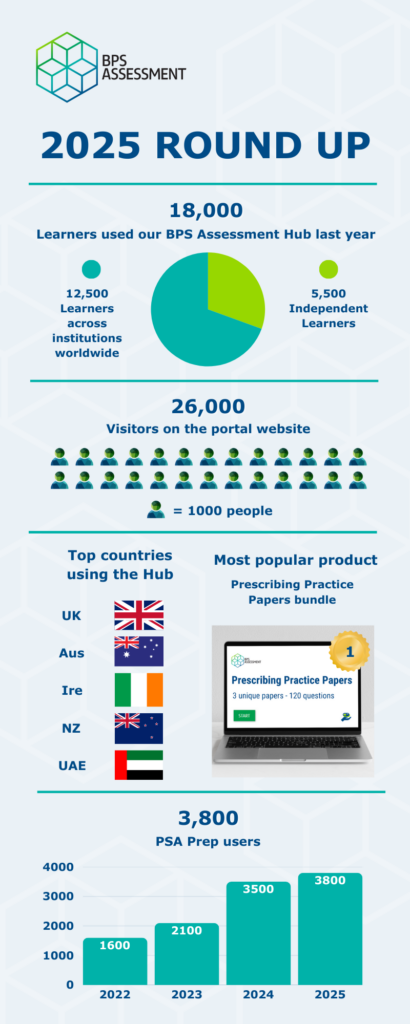
In 2025, BPS Assessment continued to develop and deliver digital learning and assessment tools that support safer prescribing across education and training settings. Over the past year, our focus has been on expanding the reach of the BPS Assessment Hub, improving our platform and products, and responding to the needs of the wider prescribing community.


The Hub provides a comprehensive platform for prescribing learning, practice and assessment. Developed with support from UK experts and aligned with current clinical guidance, it supports educators in delivering structured prescribing education, whilst helping learners build the skills required for safe practice. As prescribing safety remains a concern, reliable and well-designed digital tools play an important role in supporting and standardising teaching and assessment.


Engagement with the platform continued to grow throughout 2025. More than 26,000 users accessed the Hub, with 18,000 learners actively using our assessment and practice resources. These figures reflect ongoing confidence from universities, training providers, and healthcare organisations using the Hub to support their prescribing programmes.


International uptake of the Hub also continued to grow – in addition to strong use across the UK, organisations and independent learners accessed the platform from Australia, Ireland, New Zealand, the United Arab Emirates and other regions, demonstrating its relevance across broad education and training environments.


In the past year, we also saw a strong uptake of our assessment resources. The Prescribing Papers Bundle was the most purchased product, combining our three Practice Papers in a discounted bundle. With 120 questions, a 60-item mock exam and detailed feedback, the bundle supports programme delivery and learner preparation for the Prescribing Skills Assessment. In addition, 3,800 learners used PSA Prep, our free resources designed to complement teaching programmes and support medical students with top concerns. 


We also continued to invest in innovation, including the development of new tools such as the EPS Simulator, which enables learners to practise prescribing in a simulated electronic prescribing environment.


These developments highlight our commitment to supporting organisations and learners with prescribing education as we look forward to a new year of innovation. If your organisation is interested in learning more about how the Hub might support your programmes, please get in touch to book a demo and explore the platform in more detail.

We’re looking for 3 new Authors at BPS Assessment

Foundation level prescribers rely on high quality educational resources to develop the clinical judgement and skills they need in practice. The questions they work through during training help build confidence and competence in prescribing safely.


We’re looking for three registered doctors or pharmacists who are currently in clinical practice to join our authoring team at BPS Assessment. If you have experience working with foundation level prescribers in the NHS, this is an opportunity to draw on that experience and contribute to educational content that supports their development.


As an author, you’ll be crafting and reviewing prescribing education questions across our eight Prescribing Skill Assessment item styles. You’ll be working within our house style guide and PSA blueprint, ensuring everything aligns with standard UK practice and current BNF and NICE guidance. Your role is to create scenarios that reflect the complexity and nuance of clinical practice, with challenges that really test understanding and build competence.


We’re asking for around 10 hours per month, which allows you the flexibility to fit this work around your clinical commitments. The remuneration ranges from £35 to £105 per question, depending on the complexity and question type. One thing to note is that being a BPS Assessment author precludes being able to write, edit, review or approve content for the national high-stakes Prescribing Safety Assessment at the same time.


The resources you help create will reach thousands of prescribers at a formative stage in their careers. You’ll be contributing to a safer, more competent healthcare workforce and doing it from a position where your clinical expertise directly informs educational excellence.


If you’re interested in finding out more, get in touch with Marcus Hughes or Peter Wright at bpsassessment@bps.ac.uk  for a full job description. 


We’re excited to hear from clinicians who want to extend their impact beyond their immediate practice and help shape how the next generation learns to prescribe safely.

Celebrating New Board Member Appointments at BPS Assessment

2025 was a year of significant change for the team, and as we step into 2026, we’re excited to share some exciting news about new appointments to our Board.


These appointments bring a wealth of experience, expertise and fresh perspectives that will help shape the future direction of BPS Assessment. We’re delighted to introduce the talented individuals who will be guiding us through the next phase of growth and innovation.


Our new Board Members


Dr Neha Issar-Brown – Chief Executive Officer, BPS and Managing Director, BPS Assessment

Neha brings over 20 years of strategic and operational leadership across the UK and international health, research and innovation landscape to her dual role as CEO of BPS and MD of BPS Assessment.


Her impressive career includes senior leadership roles at major UK scientific and medical organisations, including UK Research and Innovation, the Medical Research Council, Fight for Sight and the Royal Society, where she shaped scientific research strategies, policy and funding at a national level.


Most recently, Neha has led several international projects in health and innovation and served as Director of Research and Health Intelligence at Arthritis UK, where she led the development of the charity’s first Research strategy. She currently chairs Quality for the NHS Integrated Care Board for Mid and South Essex, bringing a rich blend of experience across public, private and charity sectors.


Neha has led some of the UK’s largest cross-sector collaborations in multiple long-term conditions, precision medicine and healthy ageing. Her experience also includes developing international mobility policy for STEM researchers and serving as an advisory board member for the UK Global Talent route.


Dr John Bolodeoku – Chair of the Board

John brings extensive expertise as a Chemical Pathologist, Pharmaceutical Physician and entrepreneur. He completed his MBBS in 1986 from the University of Ibadan, Nigeria, followed by an MSc in Clinical Biochemistry from Keble College, Oxford, and an MBA from the University of Liverpool in 2008.


As a Fellow of the Royal College of Pathologists (awarded in 2008) and Fellow of the Royal Society of Biology (2021), John has worked in pharmaceutical medicine since 1997 across global, European and local country roles in drug development and medical affairs. He has held senior positions including Director, Senior Director and Vice President of Medical Affairs and Health Economics at Yamanouchi’s European Head Office in the Netherlands.


John is currently a Senior Lecturer at King’s College London and serves on several boards, having previously chaired the BPS Assessment Board for six years across two terms. His research interests include lipid metabolism, atherosclerosis and cancer biomarkers.


Lucy Murray – Non-Executive Director

Lucy Murray is a Sales Director with a strong track record of growing education and SaaS businesses across the UK and Europe. She brings hands-on experience selling into the same markets that BPS Assessment serves, giving her a practical understanding of how organisations adopt, scale and succeed with learning and assessment solutions, as well as the challenges they face.


Lucy has led international expansion for education-focused SaaS products, building commercial teams and partnerships across multiple European markets. She joins the BPS Assessment board to support its continued growth and international reach, helping extend access to high-quality prescribing education and assessment worldwide.


Shoshana Bloom – Non-Executive Director

Shoshana is a healthcare consultant with over 25 years’ experience in healthcare, spanning NHS and commercial sectors, working on innovation, digital transformation and service redesign. She works with clients to design and scale commercially, implement new services and technology that delivers measurable clinical, patient experience, and financial results.


Shoshana brings previous board-level perspective as a Non-Executive Director at Pharm@Sea Ltd, a subsidiary of University Hospitals Sussex NHS Trust, alongside prior experience from senior roles in global health businesses. She holds MSc degrees in Global Public Health and Collaborative Healthcare Management and contributes to digital health evidence base through own research and through peer review for international journals.


BPS President-Elec 

Professor Simon Maxwell – President-Elect (2026-2028)

We’re also pleased to announce that British Pharmacology Society (BPS) members have voted for Professor Simon Maxwell to become President-Elect, a role he will hold from 1 January 2026 before commencing his Presidency on 1 January 2028.


Simon is Professor of Student Learning/Clinical Pharmacology and Director of Clinical Pharmacology & Therapeutics Teaching at the University of Edinburgh. His expertise in developing e-learning strategies to support Clinical Pharmacology and Therapeutics education has been transformative, and he brings valuable NHS clinical experience through his supervision of acute medical admissions and management of outpatients at increased cardiovascular risk.


As former Chair of the BPS Prescribing Committee, Simon was the lead author of the core curriculum for CPT teaching in UK medical schools. He also serves as Medical Director of the Prescribing Safety Assessment, the national online exam for UK medical students and doctors that tests competency in prescribing medicines safely. 


He will also be a keynote speaker at the 20th World Congress of Basic & Clinical Pharmacology in Melbourne, Australia, in July 2026.


An exciting new chapter

These appointments mark an exciting new chapter for both BPS and BPS Assessment.


Professor Sir Mark Caulfield, President of BPS, said: “We are delighted to welcome our new board members. They bring deep expertise in research strategy, clinical practice, governance and a strong commitment to supporting scientific communities. Their leadership will be invaluable as we continue to champion pharmacology and support our diverse membership.”


Professor Cherry Wainwright, President of BPS, added: “These appointments come at a pivotal time for our community. The depth of experience and enthusiasm for strategic leadership in science and medicine that our new board members bring will be a tremendous asset as we continue to strengthen our influence and impact.”


Dr Neha Issar-Brown commented: “I am delighted to be joining BPS and BPS Assessment at a time when pharmacology has never been more important in the national research and health landscape. I’m excited to work alongside our exceptional community to build on the strong foundation and ensure we continue to drive influence, insight and impact across the UK and globally.”


We extend our warmest congratulations to all our new board members and look forward to the expertise and leadership they will bring.

 

#MedSafetyWeek 2025

Med Safety Week runs from 3rd to 9th November 2025, marking its tenth anniversary as a global campaign to raise awareness about reporting suspected adverse drug reactions. This year’s theme “we all have the power to make medicines safer” is particularly relevant for medical students, trainees, educators and practising prescribers.


Here’s a statistic that might come as a surprise, less than 10% of adverse drug reactions are ever reported. That’s a significant gap when you consider that pharmacovigilance systems rely heavily on these reports to identify safety signals, update prescribing guidance and protect patients.


Every unreported adverse drug reaction (ADR) represents a missed opportunity to build a fuller picture of how medicines perform in real-world settings, across diverse patient populations and over extended periods.


Using Med Safety Week as a teaching opportunity

Med Safety Week provides a timely reminder to embed pharmacovigilance into your curriculum in a way that feels relevant.


When presenting clinical scenarios, you could include opportunities for students to identify potential adverse reactions and discuss whether they’d warrant a report. The MHRA publishes case studies showing how Yellow Card reports have led to regulatory action which can be used as teaching materials to demonstrate the impact of pharmacovigilance in the real world.


Ask students to consider questions such as: Have they witnessed a suspected ADR during clinical placements? Was it reported? If not, why not? What were the barriers? This kind of reflective discussion helps identify the practical challenges that lead to underreporting.


For students preparing for their prescribing exams The Prescribing Safety Assessment (PSA) includes questions on adverse drug reactions and understanding when and how to report suspected side effects is a core competency expected of newly qualified prescribers.


Resources for Med Safety Week

The MHRA and Uppsala Monitoring Centre provide free campaign materials that can be used in lectures, shared on social media or displayed in teaching spaces who-umc.org/medsafetyweek


BPSA’s own MHRA Yellow Card scheme assessment is a free to use resource that has been developed in partnership with the Medicines and Healthcare products Regulatory Agency (MHRA) and the British Pharmacological Society (BPS). It provides structured learning across two modules, covering the role of the MHRA and scenario-based case studies on reporting adverse incidents. It’s available through our portal and takes approximately one hour to complete portal.bpsassessment.com/product/yellow-card-scheme


Useful links

How BPS Assessment Supports Prescribing Skills

In today’s complex healthcare environment, the ability to prescribe safely and effectively is a critical skill for medical professionals. As healthcare continues to evolve, the need for rigorous training and assessment in prescribing has never been more important. In this blog, we take a look at the Prescribing Skills Assessment and how this important learning tool is supporting the development of these vital skills.


The Importance of Prescribing Skills


Prescribing is more than just selecting the correct medication; it involves a deep understanding of pharmacology, patient-specific factors, potential drug interactions, and ongoing monitoring. Errors in prescribing can lead to significant patient harm, making it crucial that healthcare professionals are well-trained and confident in their prescribing abilities.

We at BPS Assessment, recognise this need and have developed the Prescribing Skills Assessment to ensure that medical students and healthcare professionals from outside of the UK medical training programme, are thoroughly prepared to take on the responsibilities of prescribing.


What is the Prescribing Skills Assessment?


The Prescribing Skills Assessment is a comprehensive tool designed to evaluate the prescribing competence of healthcare professionals and trainee doctors. Unlike the UK’s national Prescribing Safety Assessment (known as PSA), which is a mandatory exam for final-year medical students and foundation doctors, the Prescribing Skills Assessment is a flexible tool that can be tailored to meet the specific needs of different institutions and learners.

The Prescribing Skills Assessment, while structured similarly to the UK PSA, is used as a formative learning tool to drive the development of prescribing competencies through realistic clinical scenarios. It covers essential areas such as:

  • Drug selection and dose calculation: Ensuring the right medication and dosage is prescribed for each patient based on their current health and medication.
  • Monitoring and reviewing therapy: Understanding how to follow up on a prescription, assess its effectiveness, and make necessary adjustments.
  • Avoiding prescribing errors: Recognising potential pitfalls, such as drug interactions or contraindications, and taking steps to avoid them.

How the PSA Supports Learning and Development


One of the key strengths of the Prescribing Skills Assessment is its focus on practical, real-world application. The assessment is designed to reflect the kinds of situations that healthcare professionals encounter in their daily practice, helping students and practitioners develop the confidence and competence they need to prescribe safely.


Tailored for Different Learning Environments


The flexibility of the Prescribing Skills Assessment makes it an ideal tool for various educational settings. It can be used by medical schools, nursing programmes, and other healthcare education institutions to assess and develop their students’ prescribing skills. Institutions can integrate the exam into their curricula, using it as a formative assessment tool to identify areas where students need further development.


Comprehensive Feedback


One of the standout features of the assessment is the detailed feedback it provides. After completing the assessment, candidates receive a breakdown of their performance in different areas of prescribing with further details on optimal and sub-optimal ways in which to treat the  patient. This feedback is invaluable for guiding study and practice, helping learners to focus on their specific areas of weakness and improve their overall competence.


Supporting Continuous Improvement


For institutions, the Prescribing Skills Assessment is not just an assessment tool; it’s a resource for continuous improvement in teaching and learning. By analysing the results and feedback from their students or trainees, educators can identify trends, adjust their teaching methods, and ensure that their programs are effectively preparing students for the challenges of prescribing in clinical practice.


The Role of BPS Assessment in Enhancing Prescribing Skills


Our commitment to supporting prescribing education goes beyond the Prescribing Skills Assessment. We also provide a suite of resources and tools designed to complement the assessment and further develop prescribing skills.

eLearning Modules


We offer over 50 targeted eLearning modules that cover essential pharmacology and prescribing topics. These modules are designed to reinforce the knowledge required for effective prescribing and provide a solid foundation for the skills assessed in the Prescribing Skills Assessment.


Practice Papers and Practice Exams


To help students prepare for the Prescribing Skills Assessment, we provide practice papers and even simulated assessments. These resources allow learners to familiarise themselves with the format of the exam, practise their time management, and refine their decision-making skills in a controlled environment.


Prescribing is a critical skill that requires a combination of knowledge, experience, and sound clinical judgement. The Prescribing Skills Assessment is a vital tool in supporting the development of these skills. By offering a flexible, comprehensive, and practical assessment, along with a range of supporting resources, we can help institutions support their healthcare trainees to prescribe safely and effectively.


Whether you’re a student, educator, or healthcare professional, we offer a pathway to mastering the art and science of prescribing, ensuring that every prescription is a step towards better patient care. Get in touch today to find out how you can implement our prescribing resources in your institution. Email us at team@bpsassessment.com

A User-Friendly Guide to BPS Assessment’s Prescribing Tools

Teaching prescribing can be tricky, with many professors and academics struggling for time and resources. But with BPS Assessment’s suite of prescribing tools, institutions have access to a collection of resources developed specifically to improve prescribing and patient safety. Let’s delve into the range of products offered and how they cater to your needs.


1. Prescribing Skills Assessment

The Prescribing Skills Assessment, not to be confused with the UK Prescribing Safety Assessment (PSA) stands as a cornerstone for evaluating prescribing proficiency among medical and healthcare students. Its assessment framework taken from the UK PSA not only measures theoretical knowledge but also assesses practical prescribing skills in simulated clinical scenarios. By utilising this formative exam, institutions can pinpoint areas of strength and weakness, enabling targeted interventions and ensuring that graduates are well-prepared for safe and effective prescribing in clinical practice.


2. eLearning Modules

Our eLearning modules serve as dynamic supplements to traditional teaching methods, catering to diverse learning styles. These interactive modules cover a wide range of prescribing topics, from pharmacology principles to drug interactions, allowing students to deepen their understanding at their own pace. With engaging content and real-world case studies, these modules enhance theoretical knowledge and practical skills, providing a comprehensive learning experience for medical, pharmacy and nursing programs alike.


3. CPT Elective

The Clinical Pharmacology and Therapeutics (CPT) elective offers a unique opportunity for medical students to immerse themselves in the world of prescribing. Through hands-on clinical scenarios and expert guidance, students gain invaluable experience in making evidence-based prescribing decisions, understanding drug mechanisms, and managing patient medications effectively. As part of this elective course students will first test their existing knowledge with our pre-course knowledge check, then work through a series of eLearning sessions to strengthen their skills and understanding. Lastly, they will complete a final assessment to evaluate their clinical reasoning and decision-making skills but also their preparedness for complex prescribing in diverse healthcare settings. 


4. Platform Licensing Offering

For institutions seeking a comprehensive prescribing solution, we offer platform licensing. This customisable option provides access to a suite of prescribing tools, including the prescribing platform, question authoring console with question templates and drug bank, each of which can be tailored to meet specific institutional needs. With flexible licensing arrangements and ongoing support, institutions can integrate these tools seamlessly into their curriculum, ensuring a cohesive and effective approach to teaching prescribing.


By leveraging these prescribing tools, institutions can create a dynamic learning environment that fosters competence and confidence among aspiring healthcare professionals. Embrace innovation, empower learners, and elevate the standard of prescribing education with BPS Assessment. Take a look at our products and services page or get in touch with the team to arrange a platform demo.